One-Pagers
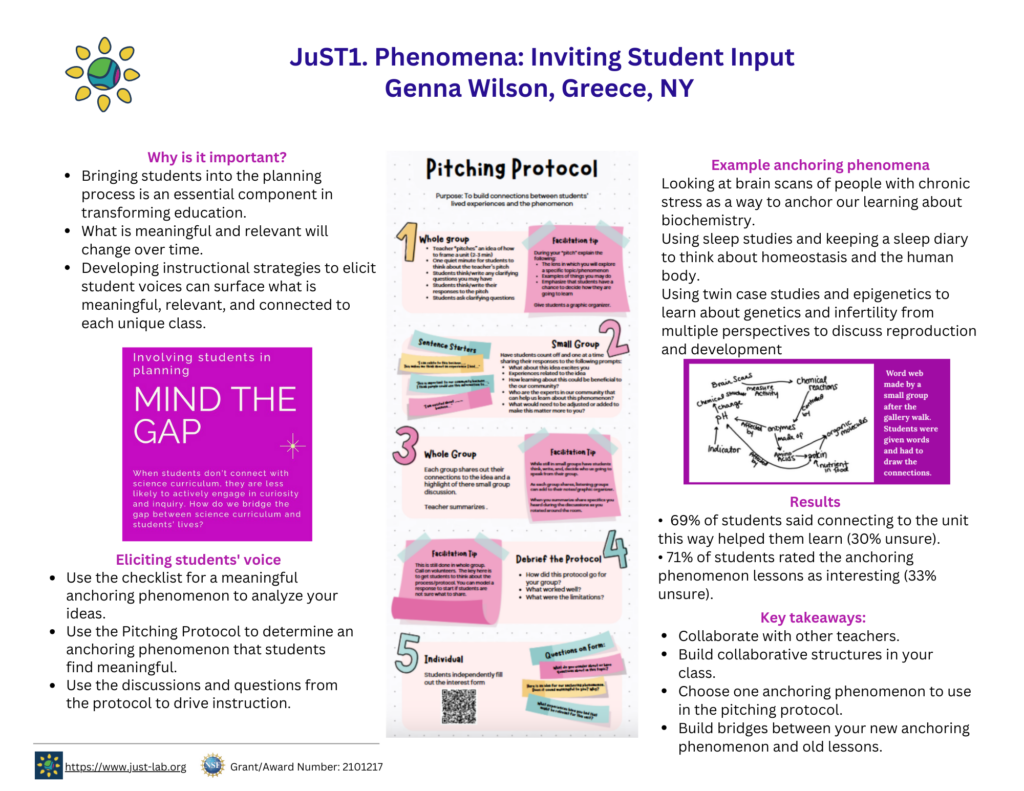
JuST 1: Bridging the Gap by Genna
Genna’s resource focuses on making science education more relevant and engaging by involving students in the planning process. It introduces the “Mind the Gap” approach, which addresses the disconnect between science curriculum and students’ lived experiences.
Genna’s “Pitching Protocol” is designed to help teachers build connections between students’ personal experiences and scientific phenomena. The protocol consists of whole-group brainstorming, small-group discussions, and individual reflection.
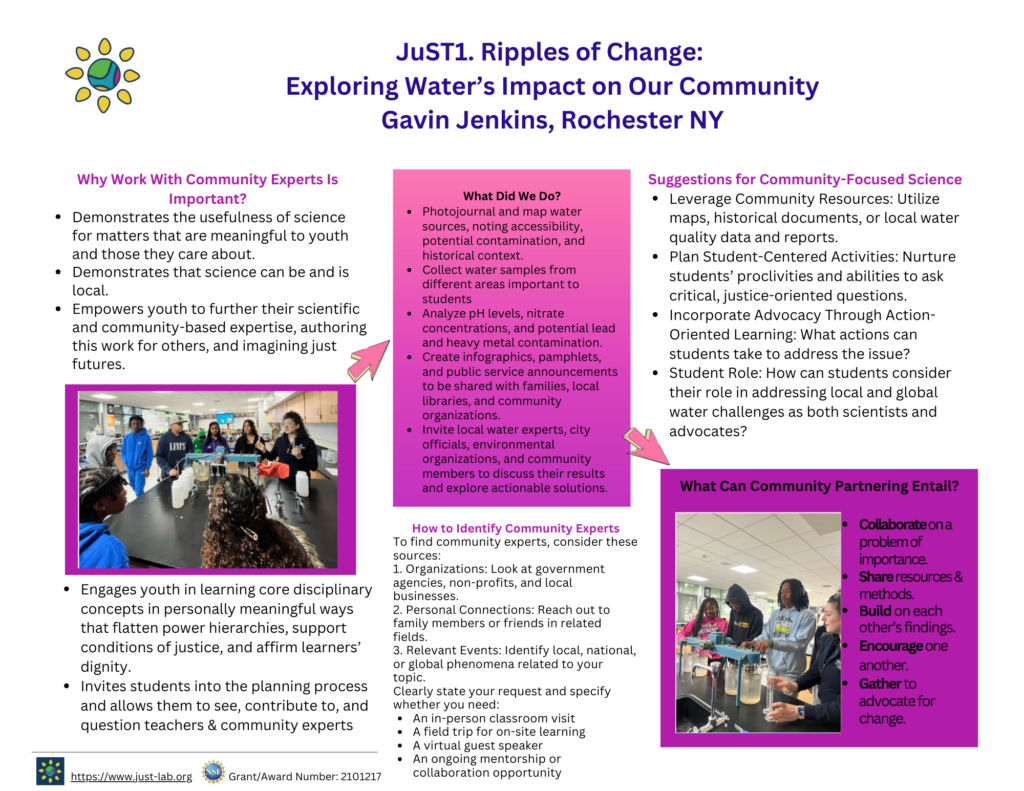
JuST 1: Ripples of Change by Gavin
Gavin’s project helps students explore the impact of water on the local Rochester community by engaging them in hands-on science that is directly relevant to their own backyard. His initiative shows how science can address issues meaningful to youth and empower them to engage with their local community.
As part of his project, Gavin had students photojournal and map water sources, collect and analyze water samples for pH, nitrates, lead, and heavy metals, and create infographics and public service announcements. His students collaborated with local water experts, city officials, and environmental organizations to discuss results and solutions.
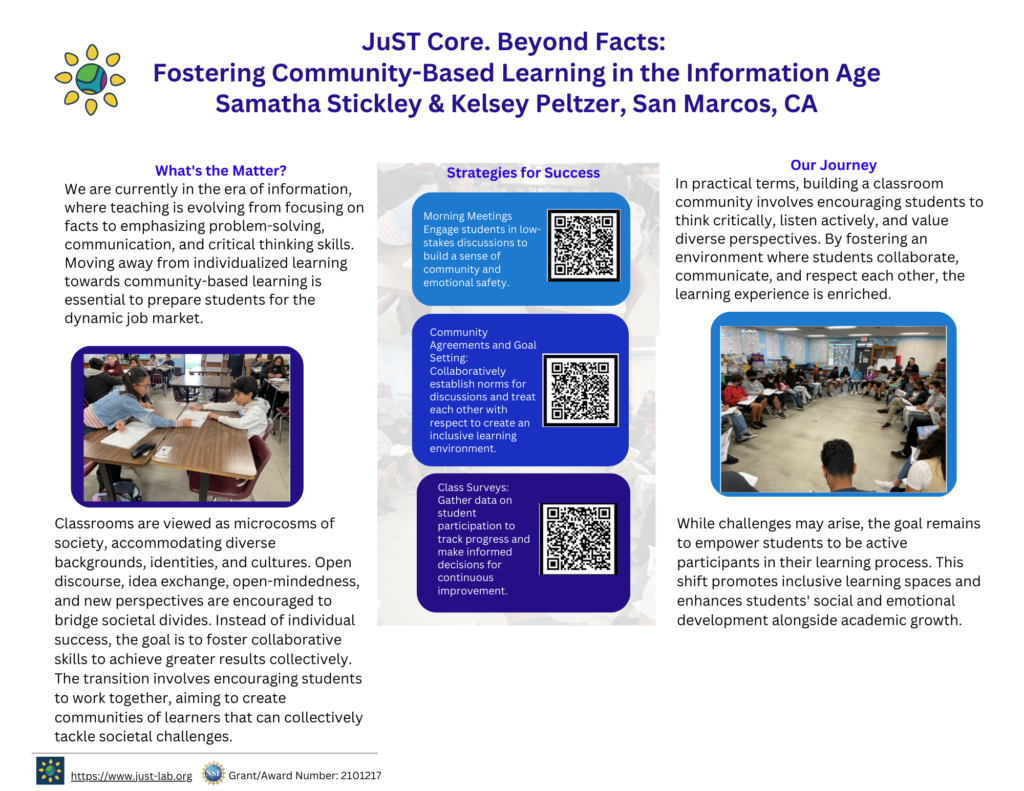
JuST Core: Building Classroom Communities
Samatha and Kelsey’s project focuses on shifting classroom dynamics from individualized learning to community-based learning. In today’s information era, teaching is evolving to emphasize problem-solving, communication, and critical thinking.
Samatha and Kelsey strongly believe in the role of classrooms as microcosms of society, striving to accommodate diverse backgrounds and perspectives. Their goal is to foster collaborative skills, open discourse, idea exchange, and new perspectives. Some of Samatha and Kelsey’s success strategies include holding morning meetings, developing community agreements, and administering class surveys, all to help build a better classroom community.
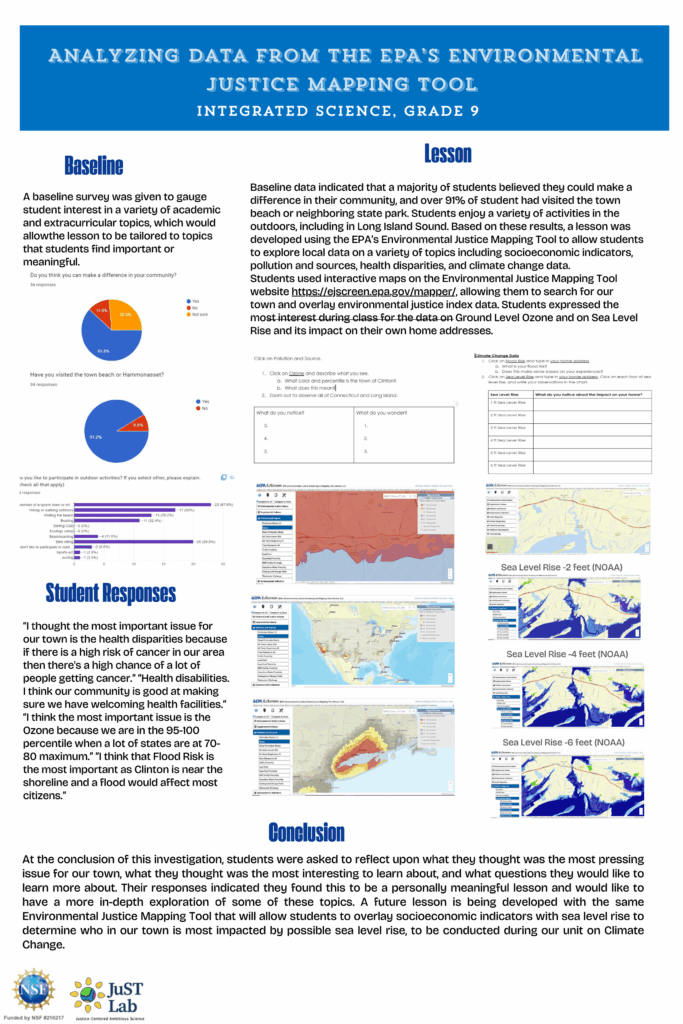
JuST 3: Analyzing Local Environmental Justice Data
This lesson uses the EPA’s Environmental Justice Mapping Tool to explore local environmental data. Students used interactive maps to investigate topics such as socioeconomic indicators, pollution, health disparities, and climate change data. The students were particularly interested in ground-level ozone and sea level rise and discussed how these issues directly impact their homes and community.
JuST 3: Race and Genetics
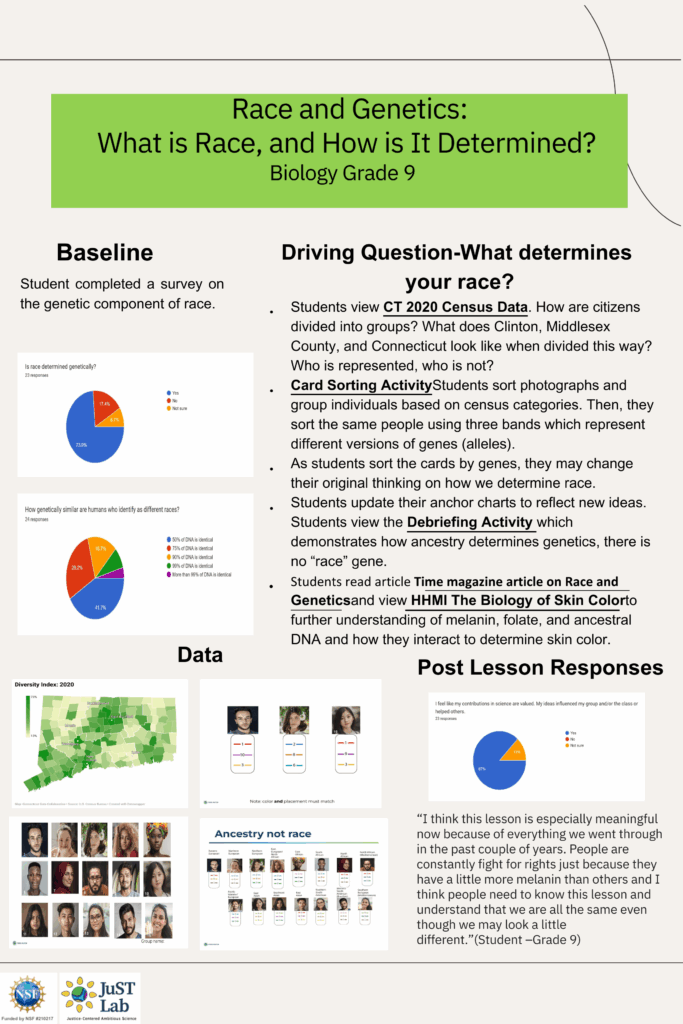
This lesson investigates the relationship between race and genetics. The driving question of the lesson—What determines your race?—guided students through several activities. They analyzed CT 2020 Census data to see how citizens are categorized and who is represented or underrepresented. Students participated in a card sorting activity where they grouped individuals by census categories and genetic alleles. Students also updated anchor charts and engaged with a TIME magazine article on race and genetics, as well as an HHMI video on the biology of skin color.
JuST 3: Exploring Equity in Environmental Science
In this lesson, students explored how climate change exacerbates the unequal impact of extreme heat. Students began by discussing and writing “Notice and Wonder” statements based on their data. Throughout the lesson, students created models, put together a class question board, and watched a documentary about tree equity.
Students used the American Forests Interactive Tree Equity Map to compare data. They also discussed the responsibilities of individuals, communities, and governments in ensuring equitable access to urban green spaces.


JuST 3: Connecting Chemistry to Local Environmental Issues
In this lesson, students explored ocean acidification in the Long Island Sound. They used local data to help connect what they learned in the classroom to real-world environmental challenges.
This lesson introduced students to the phenomenon of acidification in the Long Island Sound. Specifically, it put an emphasis on factors such as dissolved oxygen, hypoxia, water temperature, pH, aquatic life, and sea surface temperature. Students engaged in a jigsaw activity, analyzed graphs of water temperature trends and global pH levels, and worked with local data on dissolved oxygen levels.
JuST 3: Exploring the Intersection of Diabetes, Food Deserts, and Social Justice
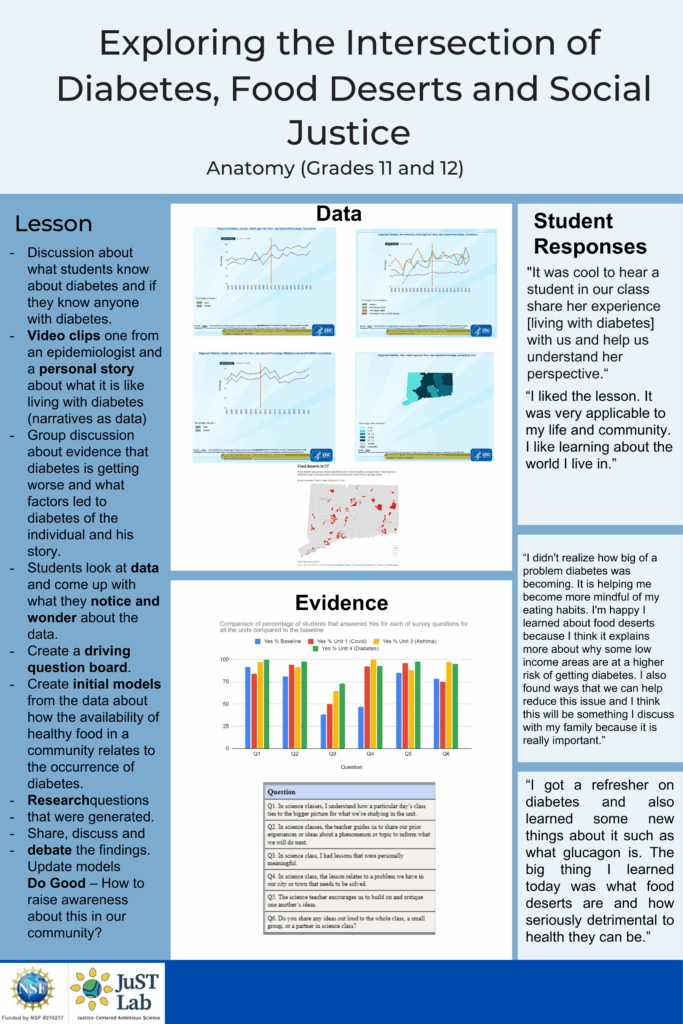
Students began this lesson by discussing their knowledge of diabetes and whether they knew anyone affected by it. They also watched video clips about living with diabetes to help build a baseline for further analysis.
Students engaged in group discussions about evidence showing the worsening diabetes crisis and the factors contributing to it. They analyzed data on food deserts in Connecticut and created a driving question board. This helped them developed initial models to explain the relationship between food availability and diabetes occurrence.

JuST 3: Analyzing Trends in Heat-Related Illnesses in Connecticut
In this lesson, students investigated how heat-related illnesses disproportionately affect at-risk individuals in Connecticut. They analyzed data on days with maximum temperatures exceeding 90°F, identifying counties with the highest rates and comparing urban versus non-urban areas. Students also examined Emergency Department (ED) visits for heat indices exceeding 95°F and broke down the data by age group.
Students completed “Notice and Wonder” activities, summarized their findings, and discussed the connections between age, gender, frequency of ED visits, and heat-related illness. They also explored preventative measures in a post-lesson survey.
Building a Critical Community by James (High school chemistry teacher)
This resource assists teachers in developing a critical community to empower students to identify power injustices and take action toward equity and justice. By analyzing how their own identities shape their beliefs and values, students learn to recognize whose voices are represented in science—and whose are missing.
Teachers build critical communities through three core practices: Identity Mapping (examining how identities intersect), Anchoring Phenomena (exploring science through a justice lens), and Community-Facing Performance Tasks (positioning students as agents of change).
Students who develop critical consciousness show higher academic achievement, deeper engagement, greater empathy for classmates, and stronger preparation for real-world conversations about equity and injustice. It transforms science from an abstract subject into purposeful learning tied to community needs and social change.
Community Connections by James (High school chemistry teacher)
This resource supports teachers in designing community-connected science learning experiences that help students evaluate real-world information, using the pandemic as a relevant context. Students build skills in identifying misinformation, engaging with local experts, and incorporating feedback through peer and community review. The sequence culminates in authentic projects, like student-created FAQ materials, that share reliable information beyond the classroom. It also encourages educators to foster student agency and use assessment as a tool for meaningful, real-world impact.
Do Good Projects by Catherine
This resource helps teachers develop “Do Good Projects”, which challenge students to use science and evidence to advocate for social justice. As part of such projects, students investigate a real-world issue, analyze data that illuminates the problem, and create a community-facing product—such as a public service announcement, social media campaign, or letter to decision-makers—with the intent of educating others and inspiring change.
This approach helps students recognize that science plays a critical role in addressing social injustice while positioning them as changemakers capable of real-world impact. By grounding their advocacy in evidence gathered and analyzed in class, students engage in the NGSS practice of arguing from evidence while tackling issues that matter to them and their communities.
Teachers can implement this in four steps: introduce a justice-centered phenomenon, guide students through data analysis, facilitate class discussion about how evidence can drive advocacy, and assess student learning through the final project.
Eliciting and Capturing Cultural Connections by Katrina
This teaching strategy invites students to connect their lived experiences to scientific phenomena. When presented with a phenomenon, students brainstorm similar things they’ve encountered in their own lives. Their ideas are collected, organized, and evaluated in small groups for similarities and differences to the original phenomenon. Groups then arrange their connections on a visual “target,” placing the most similar items near the center and the most different ones farther out. A class-wide discussion builds a shared target that evolves as students deepen their understanding. The approach honors student experiences, makes diverse thinking visible, builds community through discussion, and establishes a classroom culture that values connections between content and real life.
Identity Mapping by Ellie
This resource assists teachers with implementing various parts of the JuST Framework in their own classrooms. Here, students see themselves as part of the scientific community by starting with their own identities, backgrounds, and experiences. Students explore how diverse scientists bring their whole selves to their work, investigate real-world phenomena affecting their communities, design their own experiments to answer meaningful questions, and share what they learn through peer-reviewed resources. By grounding science in student identity and local relevance, this approach makes learning more engaging and equitable.
Localized Anchoring Phenomenon – by Ellen (Middle school science teacher)
This resource supports teachers in launching units with a localized, justice-centered anchoring phenomenon that connects science to students’ lived experiences. Through analyzing real-world data, exploring multiple perspectives, and sharing personal insights, students investigate why communities are impacted differently by issues happening in their neighborhoods. Their questions drive the learning through a collaborative Driving Question Board, fostering curiosity and relevance. The approach emphasizes the intersection of science and social inequities while encouraging meaningful, student-centered inquiry.
Modeling science in Context by Breanna and Katrina (High school chemistry teachers)
This resource helps teachers use scientific modeling as a tool for equity, positioning students’ ideas, experiences, and community knowledge as central to sensemaking. Students develop and revise models over time, engaging in discussion, investigation, and reflection to deepen their understanding of real-world phenomena. The approach emphasizes student voice, collaborative discourse, and the ongoing nature of scientific knowledge. Practical strategies support teachers in fostering inclusive participation, guiding student thinking, and making time for meaningful model revision.
The Power of Perspective Taking by Rachel
This resource assists teachers with harnessing the power of perspective taking in their own classrooms. Perspective taking is a powerful teaching strategy that encourages students to consider multiple points of view, develop empathy, and think critically about important issues beyond their own biases and assumptions. In science classrooms, CRAFTS (Culturally Relevant, Role, Audience, Format, Topic, Social Justice) activities create meaningful opportunities for students to embody different perspectives, which could be anything from that of a water molecule moving through the local water cycle, a polar bear affected by climate change, or even members of a community facing real-world science challenges. By stepping into these roles and addressing specific audiences in authentic formats, students deepen their understanding of science content while also developing compassion and recognizing the human and environmental impacts of scientific phenomena. These adaptable activities foster inclusive classroom environments where students feel comfortable sharing diverse perspectives, connecting science to their communities and daily lives.
Solo Walks and Joy by Christina
This resource helps teachers build a welcoming and joyful community that enhances science learning by creating reciprocal emotional and physical safety. Rather than simply focusing on fun, this approach recognizes and celebrates students’ varying nature-culture relationships while advancing equity in science education. This resource explores critical questions about assessing student relationships with nature, understanding power dynamics, and ensuring all voices are represented. Some strategies that teachers can utilize include incorporating social-emotional learning through reflective activities like solo walks with body scans and journaling, sharing identity stories to foster connectedness, and creating space for play-based experiential learning that associates joy with science concepts. By implementing these practices, educators can better understand their students as scientists, address historical inequities that affect marginalized communities’ outdoor engagement, and cultivate a genuine sense of belonging in their classrooms.
Tree Talk by Molly
Tree Talk was a 2024 project supported by the University of Rochester’s Institute for Human Health and the Environment that brought together grades 5–8 students from an urban school garden club to tackle inequitable access to trees. Students collaborated with community experts, including groundskeepers, neighbors, and environmental educators, to investigate the problem and drive change. The initiative successfully resulted in the planting of over 40 trees throughout Rochester and culminated in a student-led community celebration that united diverse stakeholders who had never previously connected. Rooted in the Justice-centered ambitious Science Teaching (JuST) Framework, the work positioned young people as transformative intellectuals capable of learning science and wielding it as a tool for social transformation, demonstrating how recognizing and valuing community expertise deepens youth engagement and builds lasting momentum for environmental justice work.